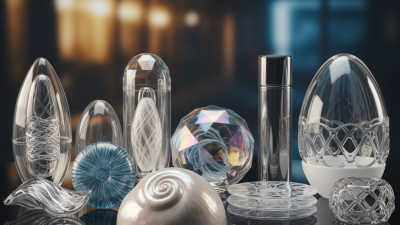
What Is Glass Shell and Which Type Is Best for Sourcing?
Glass Shell sourcing is gaining attention as brands seek visible protection, clean presentation, and recyclable materials. A Glass Shell may refer to a glass cover, housing, vessel, or protective enclosure. Its best form depends on use, not appearance alone.
The Grand View Research Glass Packaging Market Report estimated the global market at approximately USD 82.8 billion in 2023. Its analysis also identifies food, beverages, cosmetics, and pharmaceuticals as major demand sectors. These figures show scale, but they do not guarantee supplier quality. Buyers still need to inspect wall thickness, glass grade, thermal resistance, surface defects, and dimensional tolerance.
Adeline Farrelly, Secretary General of the European Container Glass Federation, stated, “Glass is the only packaging material that is 100% and infinitely recyclable.” Her point supports glass’s circularity advantage, when collection and recycling systems work properly. The Ellen MacArthur Foundation also emphasizes designing packaging for reuse, recovery, and material efficiency.
The best Glass Shell type is therefore application-specific. Borosilicate glass suits heat exposure and laboratory conditions. Soda-lime glass usually offers lower costs for decorative and everyday products. Tempered glass improves impact resistance, while laminated designs can reduce dangerous fragmentation.
No single shell wins every brief. That is the inconvenient part.
Sourcing teams should request samples, test reports, food-contact documentation where relevant, and factory quality records. They should also compare minimum order quantities, mold charges, breakage rates, and export packaging. A polished sample can hide weak production control. Careful validation remains more reliable than attractive photographs.
What Is a Glass Shell and What Are Its Main Characteristics?
A glass shell is a hollow glass enclosure shaped to protect or contain an inner component. It may resemble a clear capsule, cover, bulb, or small vessel. Its transparency allows users to inspect contents without opening the shell. This feature supports visual quality checks during manufacturing and use.
Glass shells offer strong chemical stability, a smooth surface, and resistance to odor absorption. Their heat performance depends on the glass composition and wall thickness. Borosilicate glass handles thermal changes better than ordinary soda-lime glass. Soda-lime glass usually provides lower costs and easier mass production. However, every shell remains brittle under impact. Small chips around the rim can become serious failure points. I have seen samples pass appearance checks but fail after repeated temperature changes. That result deserves closer review.
Tips: Ask for material certificates, dimensional drawings, and tolerance data before ordering. Check the opening diameter, wall thickness, surface finish, and packaging method. Request samples from the actual production process. Do not judge quality from clear appearance alone. For sourcing, choose the glass type according to temperature, chemical exposure, impact risk, and budget. A thicker shell is not automatically better. Excess thickness may increase weight, cost, and forming difficulty. Confirm inspection methods, rejection standards, and replacement terms in writing. Supplier communication can still be imperfect, so record every technical detail.
How Is a Glass Shell Made and What Materials Are Used?
A glass shell is a formed glass enclosure used around a product, component, or decorative object. Its production starts with carefully measured raw materials. Silica sand provides the main structure. Soda ash lowers the melting temperature. Limestone improves chemical stability and durability. Recycled glass, called cullet, can also enter the mixture. It helps reduce energy use when properly sorted.
The batch melts inside a furnace at extremely high temperatures. Workers or automated systems then shape the molten glass through pressing, blowing, drawing, or molding. For a consistent shell, mold temperature matters greatly. Uneven cooling may create stress, distortion, or small cracks. Annealing slowly removes internal stress. This step is easy to underestimate, but it strongly affects reliability.
Soda-lime glass suits many general-purpose shells because it offers reasonable cost, clarity, and production speed. Borosilicate glass performs better where heat changes or chemical exposure are expected. Tempered glass may improve impact resistance, though it requires controlled processing. The best material depends on temperature, wall thickness, transparency, and expected handling. Sourcing teams should request material specifications, tolerance data, and sample testing. Inspect edges under bright light. Tiny chips often become larger failures later. The decision is not always neat. A thicker shell may feel safer, yet it can increase weight and transport costs.
What Are the Common Types of Glass Shells?
A glass shell is the outer glass body that protects, contains, or presents a product. It may cover a lamp, instrument, display, container, or decorative object. During sourcing, buyers should examine wall thickness, edge quality, clarity, and dimensional tolerance. A beautiful sample can still fail after repeated heat exposure.
Soda-lime glass is the most common option. It offers reasonable cost, clear appearance, and efficient mass production. It suits ordinary lighting covers, display parts, and decorative containers. Borosilicate glass handles rapid temperature changes better. It is useful for laboratory items, cooking accessories, and hot-liquid applications. However, it usually costs more and may require stricter forming control.
Tempered glass is heat-treated for improved impact resistance. When it breaks, it usually forms small fragments instead of sharp shards. It works well for protective covers and larger flat shells. Laminated glass contains an internal plastic layer, helping hold fragments together after breakage. Frosted, colored, coated, and textured glass are appearance options rather than separate base materials. They affect light diffusion, surface feel, and cleaning performance.
Choose by use, not appearance alone. Ask suppliers for heat-shock results, hardness data, dimensional reports, and sample testing. Check the shell under real conditions, including handling, assembly pressure, and temperature changes. Small flaws matter. A faint bubble may be acceptable in decoration but unacceptable near a light source or viewing window. Supplier advice is valuable, yet independent inspection remains necessary. My own sourcing preference is to test fewer assumptions before approving a large production run.
What Is Glass Shell and Which Type Is Best for Sourcing?
A glass shell is a protective or structural glass enclosure used around components, products, or light sources. The chart compares common glass shell materials by typical softening point and thermal expansion. Lower thermal expansion generally means better resistance to thermal shock.
Borosilicate glass is often the most balanced sourcing choice for applications requiring heat resistance and durability. Fused silica provides the highest thermal performance, while soda-lime glass is usually selected for cost-sensitive products. Aluminosilicate glass is suitable when higher strength and temperature resistance are required.
How Do Different Glass Shell Types Compare in Performance and Cost?
A glass shell is a formed glass enclosure used to protect, display, or contain a product. In sourcing work, performance depends on more than appearance. The main choices include soda-lime, borosilicate, tempered, and laminated glass. Each solves a different risk. Soda-lime glass is economical and suitable for ordinary indoor use. Borosilicate glass tolerates rapid temperature changes better. Tempered glass offers stronger impact resistance, while laminated glass improves safety after breakage.
Cost differences can be significant. Soda-lime usually provides the lowest purchase price. Borosilicate may cost more because its composition and forming process require tighter controls. Tempering adds heat-treatment charges and inspection steps. Lamination adds film, pressing, and edge-finishing costs. However, unit price is only one part of the calculation. A shell with poor edge quality may crack during assembly, creating replacement costs and delayed shipments. That hidden cost hurts.
During supplier evaluations, request test data for thermal shock, impact, wall thickness, and dimensional tolerance. Check the actual sample under bright side lighting. Tiny edge chips can become serious failure points. Do not trust appearance alone. One sample can mislead. Small batches may show uneven thickness or inconsistent clarity. For stable indoor products, soda-lime can be the practical choice. For heat exposure, borosilicate is often safer. If breakage risk matters, tempered or laminated designs deserve closer review. The best type is not always the strongest; it is the one matching real use conditions without paying for unnecessary performance.
What Is Glass Shell and Which Type Is Best for Sourcing? - How Do Different Glass Shell Types Compare in Performance and Cost?
| Glass shell type |
Typical composition / process |
Working temperature
(approx.) |
Thermal shock resistance |
Hardness
(Mohs, approx.) |
Light transmission |
Chemical resistance |
Indicative material cost* |
Best suited for |
Sourcing value |
| Standard soda-lime glass |
Silica-soda-lime composition; formed by pressing, blowing, molding, or float-glass processing |
Up to about 500°C continuous service |
Low |
5–6 |
High; commonly 88–92% for clear glass |
Good for common household chemicals |
US$0.80–2.00/kg |
Decorative covers, packaging shells, display housings, low-cost lighting components |
Excellent for cost-sensitive products |
| Tempered soda-lime glass |
Soda-lime glass strengthened by controlled heating and rapid air cooling |
Up to about 250–300°C, depending on design |
Medium to high |
5–6 |
High; similar to the base glass |
Good |
US$2.00–5.00/kg |
Protective covers, appliance windows, architectural shells, products requiring improved impact safety |
Best for economical safety improvement |
| Borosilicate glass |
Silica-boron oxide composition; commonly molded, blown, or machined |
About 450–500°C continuous service; higher for selected grades |
High; low thermal expansion reduces cracking risk |
7–7.5 |
High; commonly 90% or more for clear parts |
Very good against water, acids, and many chemicals |
US$3.00–8.00/kg |
Laboratory vessels, cookware, thermal components, chemical-contact housings, premium lighting |
Best overall balance for demanding applications |
| Aluminosilicate glass |
Silica-alumina composition; often chemically strengthened or thermally processed |
About 500–700°C, depending on grade and load |
High |
6.5–7.5 |
High, with good optical clarity when polished |
Very good |
US$8.00–25.00/kg |
Thin protective windows, electronic covers, high-strength instrument housings, premium consumer products |
Best where strength and thin walls justify a premium |
| Fused silica / quartz glass |
Very high-purity silica; produced by fusion, machining, or specialized forming |
About 900–1,000°C continuous service |
Very high |
5.5–6.5 |
Excellent from ultraviolet to near-infrared wavelengths |
Excellent, except for certain aggressive alkaline conditions |
US$15.00–60.00+/kg |
High-temperature laboratory equipment, UV optics, semiconductor and analytical components |
Best technical performance, rarely best for low-cost sourcing |
Data notes: Cost ranges are indicative bulk material estimates in USD per kilogram and exclude tooling, machining, coatings, decoration, packaging, freight, and quality inspection. Actual prices vary with shell dimensions, wall thickness, tolerance, order quantity, surface finish, forming method, and required certification. “Working temperature” is a general design range rather than a guaranteed limit; final selection should be validated against the supplier’s grade-specific technical data.
Which Glass Shell Type Is Best for Your Sourcing Needs?
A glass shell is an outer glass body used to protect, display, or contain a product. Choosing the best type depends on use, not appearance alone. Clear soda-lime glass suits general packaging and decorative applications. It offers good transparency, broad availability, and manageable costs. However, it may show scratches more easily during transport. Frosted glass adds a soft, premium surface, but fingerprints and coating wear require closer inspection.
For heat, pressure, or repeated temperature changes, borosilicate glass is usually the safer sourcing choice. It expands less under heat and supports demanding laboratory, lighting, and kitchen applications. It often costs more. That difference matters. Colored or coated glass can improve light control and visual identity, yet color consistency may vary between production batches. Ask suppliers for approved color samples, wall-thickness data, and inspection records before placing a large order.
The best glass shell should match the product’s real working conditions. Check impact resistance, closure fit, surface defects, dimensional tolerance, and packaging protection. Request pilot samples. Test them after drops, heating, cooling, and repeated handling. Recycled glass may support sustainability goals, but its shade and clarity can change without strict process control. A lower price can hide higher rejection rates. I would also question suppliers that provide attractive samples but avoid factory audits or material documentation. Small details matter, especially around edges and openings. ϵαποτε