Leave Your Message
Choosing the right Glass Tube in 2026 requires more than comparing prices or wall thickness. Global buyers must examine material performance, processing quality, packaging, and supplier reliability. A tube that looks flawless under warehouse lighting may crack during thermal cycling or shipping. Small details matter.
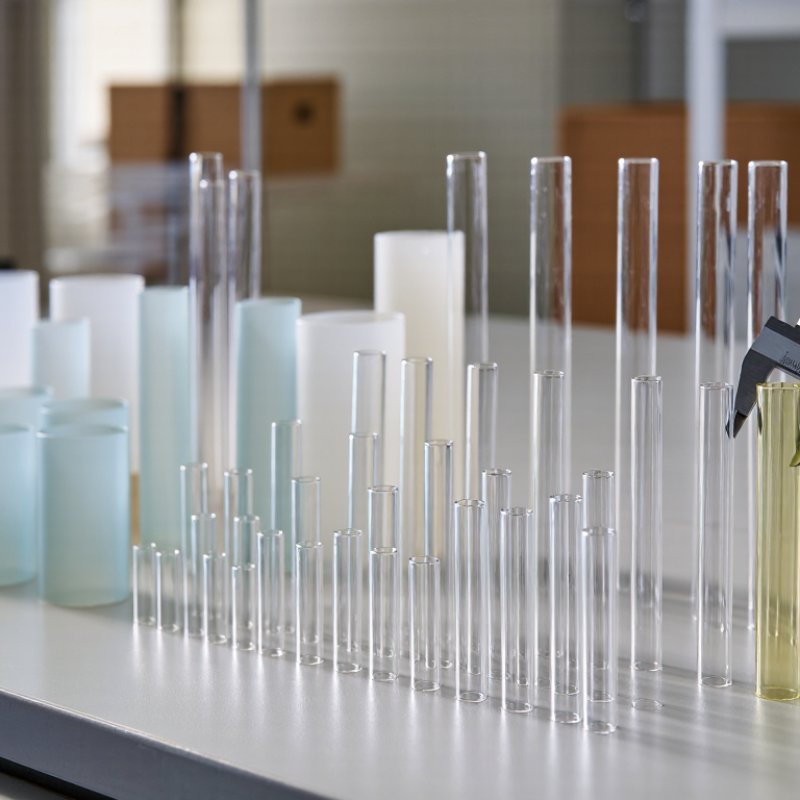
This guide introduces the main Glass Tube types used across laboratories, lighting, packaging, medical equipment, and industrial systems. Borosilicate glass suits applications requiring strong thermal resistance. Soda-lime glass often supports cost-sensitive projects and high-volume production. Quartz glass performs well under intense heat, ultraviolet exposure, and demanding chemical conditions. Aluminosilicate glass may offer improved strength where impact resistance matters.
No single choice wins everywhere.
The best option depends on temperature ranges, pressure conditions, dimensions, transparency, surface finish, and end-use requirements. Buyers should request dimensional tolerances, inspection records, material data, and sample testing before placing large orders. Certifications also deserve careful review. A familiar logo does not automatically prove consistent quality.
Supplier evaluation is equally important. Experienced manufacturers can explain forming methods, annealing processes, cutting accuracy, and defect-control procedures. Clear communication about drawings, delivery schedules, export packaging, and after-sales support reduces avoidable risk. Still, even reputable suppliers may need closer verification for custom specifications.
This overview aims to help international purchasers compare practical Glass Tube solutions with greater confidence. It focuses on evidence, not impressive claims. Some recommendations may change when application details are incomplete. That is worth remembering. A careful technical review, supported by samples and independent testing, remains the safest path toward a reliable 2026 sourcing decision.
2026 Best Glass Tube Types for Global Buyers
Glass Tube Fundamentals: Borosilicate 3.3 vs. Soda-Lime Thermal Expansion
Thermal expansion often decides whether a glass tube survives real service. Borosilicate 3.3 expands at roughly 3.3 × 10⁻⁶/K. Soda-lime glass expands near 9 × 10⁻⁶/K. The difference becomes serious during rapid heating, cooling, or uneven temperature changes. Borosilicate usually handles thermal shock better because its expansion is lower. It suits laboratory assemblies, heating systems, and sight tubes exposed to repeated temperature changes. Soda-lime remains practical for general packaging, low-temperature covers, and cost-sensitive applications.
Temperature alone is not the whole story. Wall thickness, tube diameter, heating speed, and surface scratches also affect failure risk. A thick tube may hold heat unevenly. That creates internal stress. Annealing quality matters too. Poorly released stress can cause cracking days after production. A common buying mistake is choosing glass only by maximum temperature. That approach is incomplete, and I have seen specifications overlook cooling conditions.
Tips: Ask for the coefficient of thermal expansion, annealing data, dimensional tolerances, and thermal-shock test method. Describe the actual heating cycle, not just the target temperature. If one side faces a flame or hot metal, mention it clearly. Request samples when the tube will be inserted into metal fittings. Small clearance can prevent stress. No selection rule is perfect. Validate the design under realistic temperature changes before approving large-volume production.
| Evaluation Dimension | Borosilicate 3.3 Glass Tube | Soda-Lime Glass Tube | Buyer Implication |
|---|---|---|---|
| Typical glass family | Heat-resistant borosilicate glass manufactured to the general requirements of ISO 3585 | Alkali-lime-silicate glass commonly used for general-purpose containers, tubing, and architectural products | Select the glass family according to thermal cycling, chemical exposure, dimensional accuracy, and total cost. |
| Nominal coefficient of linear thermal expansion | 3.3 × 10⁻⁶ K−1 over the commonly specified 20–300 °C range | Approximately 8.5–9.5 × 10⁻⁶ K−1; the exact value depends on composition | The lower value of borosilicate 3.3 generally reduces thermal stress during rapid temperature changes. |
| Relative thermal expansion | Low expansion; approximately 65% lower than a soda-lime glass with a 9.5 × 10⁻⁶ K−1 expansion coefficient | Higher expansion; approximately 2.7–2.9 times the expansion of borosilicate 3.3 | Borosilicate is normally preferred for repeated heating and cooling or close dimensional tolerances. |
| Typical chemical composition | Silica-rich glass with approximately 12–13% boric oxide and lower alkali content; exact composition varies by specification | Primarily silica, sodium oxide, and calcium oxide, with smaller amounts of other stabilizers and refining components | Composition should be verified when the tube will contact aggressive chemicals or pharmaceutical formulations. |
| Typical density | Approximately 2.23 g/cm3 | Approximately 2.4–2.5 g/cm3 | Borosilicate may provide a modest weight advantage at the same geometry, although wall thickness remains decisive. |
| Approximate annealing point | Approximately 560 °C | Approximately 500–550 °C, depending on composition | Thermal-processing schedules must be based on the actual glass specification and tube dimensions. |
| Approximate softening point | Approximately 820 °C | Approximately 700–730 °C | Borosilicate generally tolerates higher process temperatures before significant softening, but it is not automatically suitable for every high-temperature application. |
| Thermal-shock resistance | High relative resistance when the tube is properly designed, manufactured, and free from severe surface damage | Lower relative resistance because higher expansion generates greater thermal stress for the same temperature gradient | For hot-to-cold transitions, laboratory heating, burner-adjacent use, and thermal cycling, borosilicate is usually the safer starting point. |
| Chemical resistance | Generally very good resistance to water, dilute acids, and many laboratory chemicals; strong alkalis and hydrofluoric acid can attack glass | Suitable for many general-purpose uses, but typically less resistant than borosilicate to demanding chemical and thermal environments | Request chemical compatibility testing for concentrated alkalis, fluorides, hot process liquids, and long-term storage. |
| Dimensional stability during heating | Very good; lower expansion helps maintain bore, length, and fit during temperature changes | Moderate; greater expansion can affect fit, sealing, and alignment during heating | Choose borosilicate for assemblies with tight tolerances or glass-to-metal sealing requirements that specify a low-expansion material. |
| Common tube applications | Laboratory tubes, sight glasses, analytical components, heating-system parts, process tubing, and demanding fluid-handling assemblies | General-purpose sleeves, display and lighting components, low-temperature fluid transfer, packaging-related parts, and economical non-cycling applications | Application temperature, pressure, chemical exposure, and required service life should determine the final tube type. |
| Relative procurement cost | Usually higher because of raw materials, processing requirements, tighter thermal specifications, and specialized fabrication | Usually lower and widely available in standard sizes | Compare total cost of ownership, breakage risk, replacement frequency, and compliance—not only unit price. |
| Recommended selection scenario | Preferred: repeated thermal cycling, high temperature, chemical service, precision assemblies, and low-expansion applications | Preferred: ambient or mildly heated service, standard dimensions, low thermal shock, and cost-sensitive projects | When the operating conditions are uncertain, qualify the tube through thermal-cycle, pressure, chemical-compatibility, and visual-inspection tests. |
Technical note: Values are typical reference ranges for uncoated glass and are not universal material guarantees. Actual properties vary with chemical composition, manufacturing process, wall thickness, surface damage, thermal history, and applicable standards. The coefficient of linear thermal expansion is normally reported over a defined temperature range; always request the supplier’s technical datasheet and test method before final approval.